
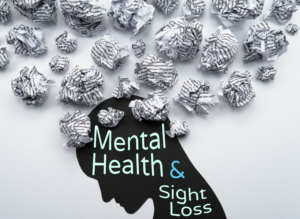
When people research vision loss, mental health rarely comes up in the same conversation. The focus is on the eyes: the diagnosis, the progression, the options.
But for many people adjusting to significant vision loss, the hardest part isn’t visual. It’s emotional. And that part often goes unaddressed for a long time.
How Common are Depression and Anxiety with Vision Loss?
Studies consistently find that depression and anxiety are significantly more common among people with vision loss than in the general population. Estimates vary, but research published in peer-reviewed journals has found that between 30% and 40% of people with significant visual impairment experience depression; rates substantially higher than the general adult population.
The connection is not surprising when you think through what vision loss actually involves. Tasks that used to be effortless become effortful. Things you used to do independently now require help, and asking for help, for many people, feels like a loss in itself. Social situations become harder to navigate. The future looks uncertain in a way it didn’t before.
For older adults, the adjustment often happens alongside other losses: of mobility, of social connection, of a sense of what daily life will look like going forward. The compounding nature of these changes matters.
What Often Makes it Harder to Get Support
Mental health support for people with vision loss is underused for a few reasons.
The first is that depression and anxiety in the context of sight loss are sometimes treated as an inevitable, natural response—which they are, in one sense, but that doesn’t mean they don’t deserve attention and treatment. A natural response to a difficult circumstance is still worth addressing.
The second is that mental health services are often not specifically designed for blind and visually impaired people. Standard therapy intake forms, waiting rooms, and written materials may be inaccessible. Some people simply don’t know that vision-loss-specific mental health support exists.
The third is stigma: both the general stigma around mental health and a specific version of it related to vision loss, which can involve a feeling that one “should be coping better.”
Where to Find Support for Vision Loss and Mental Health
VisionAware, a program of the American Printing House for the Blind, has comprehensive resources on the emotional aspects of vision loss, including guidance on finding therapists experienced with visual impairment and peer support networks.
The American Foundation for the Blind provides guidance on mental health resources specifically for blind and visually impaired people, and their Aging and Vision Loss National Center focuses on older adults navigating vision loss.
Peer support is often the most effective first step: talking with someone who has navigated the same adjustment. Many local and national blindness organizations run telephone befriending and peer support programs. The AFB’s agency locator is the best starting point for finding what’s available in your state.
Telephone counseling and telehealth have expanded significantly and may be more accessible for people who find in-person services difficult to access. Several organizations specifically offer telephone-based support for blind and visually impaired people.
The Role of Independence in Wellbeing
Research on quality of life with vision loss consistently finds that independence (the ability to do things for oneself, to feel in control of daily life) is one of the strongest predictors of well-being. This is why assistive technology matters beyond its practical function.
When someone who has stopped using their phone can make a call independently again, or read their own mail without waiting for help, the practical change is small. The emotional change isn’t. That sense of agency, the feeling that “I did that myself”, is what sits at the centre of both mental health and dignity.
It’s also why the goal of assistive technology for vision loss should always be to expand independence, not to replace it. The best technology gets out of the way and lets people do things for themselves.
A Note on Asking for Help for Vision Loss and Mental Health
The research on this is clear: people who accept and access support (from family, services, or technology) fare significantly better than those who don’t, all else being equal. The pride and self-sufficiency that make asking for help feel hard are understandable. They are also, sometimes, the thing that gets in the way.
If you or someone you care about is navigating vision loss and struggling with the emotional weight of it, there is support available that is specifically designed for this. You don’t have to navigate it alone, and asking for help is not the same as giving up.
RealSAM Pocket is a voice-operated smartphone for blind and visually impaired people — designed to support independence in daily life. Find out more →